Showing posts with label folk traditions. Show all posts

Tuesday, January 1, 2013

коледа в българия (Christmas in Bulgaria)

This year I stayed in Sofia for the winter holidays. We have two weeks off from school (yay!) and, lucky for me, I got to spend Christmas with my Bulgarian family. Kiril's folks are absolutely amazing and have welcomed me into their lives in every way.

For Christmas Eve (Budni Vecher in Bulgarian) we arrived early to help his mother, Mimi, prepare the meal. This mostly entailed making two large banitsas (homemade layered pastry filled with cheese and eggs) with fortunes wrapped in foil inside. These fortunes are a very special part of the tradition, as they tell you what kind of luck you will have in the coming tear. Kiril and I also made desserts ahead of time, which was my American contribution to the meal. We made one of my holiday favorites, peanut brittle, and toffee-nut blondies, which were a big hit.

In the Bulgarian Orthodox tradition, very much like the Catholic one I grew up with, Christmas Eve is the bigger event and is always spent with the family. Unlike the Christmases I know from my childhood, however, in Bulgaria the meal is always vegetarian. There must also be an odd number of dishes on the table, and at least 7. I think we had 11 dishes total (more dishes are supposed to bring more good luck). Usually, the dishes are fairly simple with a few traditional meatless favorites making an appearance. We ate stuffed peppers with sultanas, lutenitsa (roasted red pepper spread), fresh sheep and goat cheese, banitsa, pickled vegetables, dried fruits and nuts, and a special bread called pogacha which Kiril's brother Kalin prepared. The bread also had fortunes inside, as well as a hidden coin. When the meal begins, the oldest member of the household breaks the bread and gives it to the youngest member. And of course, the meal wouldn't be complete without a glass of delicious homemade wine.

From left to right: Kiril, me, Mimi and Kalin

On Christmas day we went over to Kiril's father's apartment for lunch. He had prepared a very hearty dish called kapama, which is made in a big clay pot and slow-cooked for at least 8 hours. Inside of the pot were layers of sauerkraut, pork, beef, chicken, two kinds of sausage, red wine, bay leaves and other seasonings. We ate this with another big pogacha, more cheese and a dried sausage called lukanka. I was the person to find the coin in the bread that time, so I should be very lucky this year. After two days of eating so much delicious food (and drinking spectacular homemade wine), I was exhausted! The rest of the week was rather a blur, and I'm happy to report that I've caught up on some very much-needed rest and relaxation. 

Photos I found online of the food- this is pogacha (bread)

And kapama, cooked in a clay pot

Saturday, September 1, 2012

There's Just Something About Mary

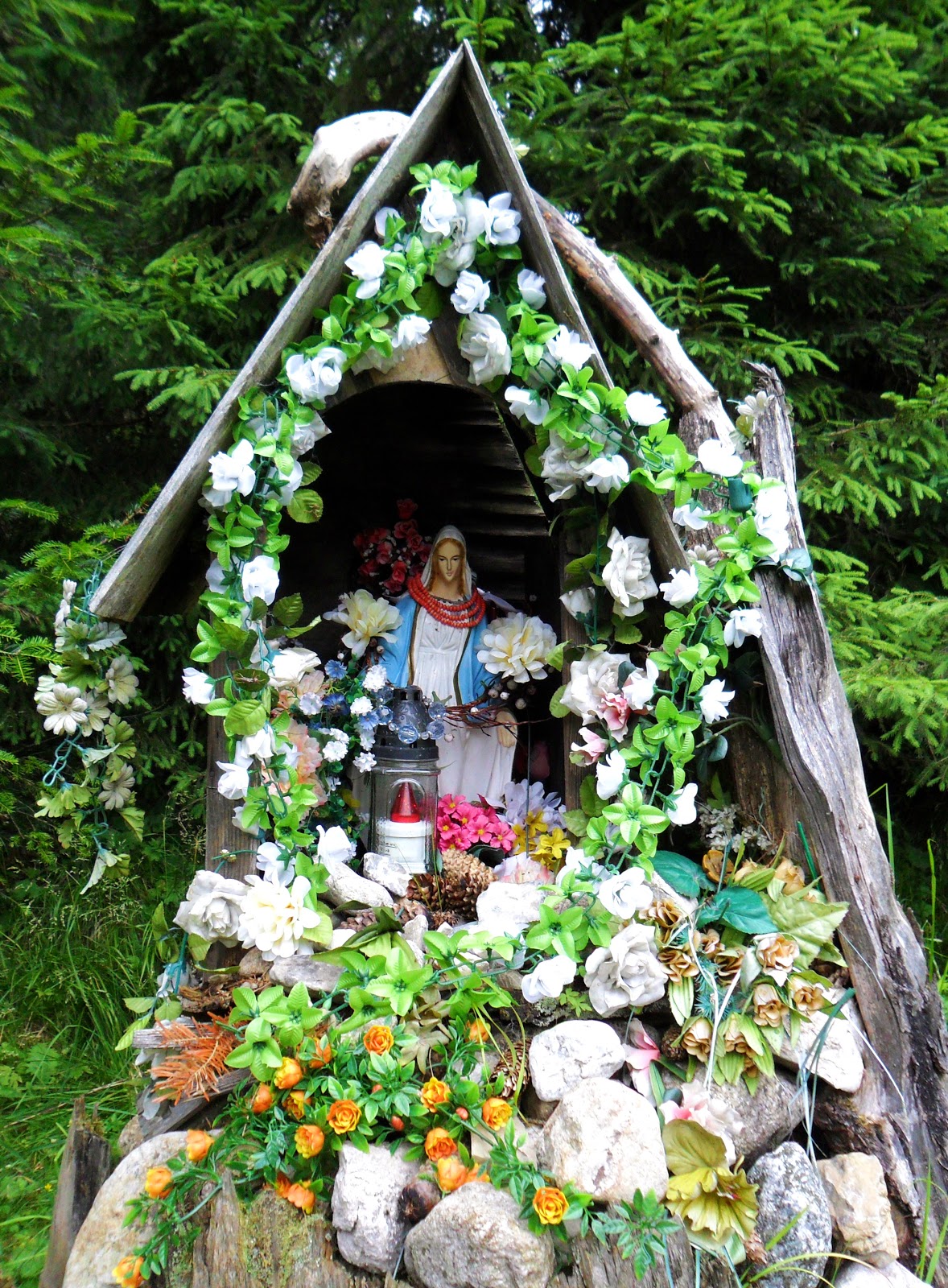
Walk through any town in Poland for ten minutes and you will find at least one of these iconic shrines to the Virgin Mary. A shrine or grotto built to venerate the Catholic Church's most worshiped saint can be found on many street corners, next to churches or even in national parks throughout the country.   


A grotto next to a small river in the Chocholuw Valley nearby the Tatra Mountains resort town of Zakopane.


This one is located in what looks like an abandoned lot on one of the main streets leading to the bus station in Zakopane. Southern Poland is considered to be more deeply religious than the north, and the town even has a chapel financed and built by local citizens as an offering of thanksgiving when the late Pope John Paul II survived an assassination attempt in 1981.


This alcove is on a street corner in the old Praga district of Warsaw, adjacent to a newly restored vodka factory-turned art facility that currently houses the Praga History Museum. I think that these shrines are quite beautiful, and wonder who takes the time to so carefully maintain them?

Tuesday, March 6, 2012

How many martenitsi are too many martenitsi?

Last Thursday, March 1st, marked a very important and unique Bulgarian holiday. Baba Marta (Grandma March), so called for the children's book character, is celebrated a month because Bulgarians look forward to the coming of spring and shaking off the winter cold. On this day people buy or make martenitsi, either bracelets or pins to be stuck to clothing, which they exchange with friends and loved ones. While each martenitsa can have many variations, the most important thing is that they are made from red and white thread. These small tokens are meant to bring the wearer good luck and health in the coming year, and it's a very sweet tradition that most people observe earnestly.


I posted some photos and wrote about martenitsi in last year's post but I didn't actually experience the holiday fully because I was on my way to England visiting relatives last March. So this year I was really looking forward to seeing how the tradition plays out at school. And I wasn't disappointed. At the First English High School here in Sofia, I was bombarded by students wanting to tie martenitsi on my wrist at the beginning of every class. After four lessons I had collected nearly 50 of them! Kiril joked that I probably hold the Guinness world record for collecting martenitsi, hahaha. I hope that means that I'll have lots of extra good luck this year.


Over the weekend we went to visit friends in Lovech, which is close to Pleven (where I lived last year). It was so nice to get away for a few days. Lovech is really quiet and peaceful compared to Sofia, with almost no traffic (people or cars) at all. Saturday was Bulgaria's independence day, and we took a walk up to the Vasil Levski monument, which was fitting because Levski was one of Bulgaria's most well-loved revolutionary heroes. The time really flew by quickly, probably because I was in such good company. I also got to catch up with my friend Dessy in Pleven, just for a couple of hours before we caught our train. I came back to Sofia feeling refreshed (although not exactly well-rested) and glad to be home. The snow is finally melting here and it looks like spring is finally on its way!  

Monday, April 18, 2011

Tsvetnitsa in Lovech

As I already mentioned, Sunday was Tsvetnitsa, or the Bulgarian celebration of flowers. It was also Palm Sunday, which is one week before Easter. If your name comes from any type of flower in Bulgarian, Sunday was your name day. Everyone has a name day, which usually falls on the feast day of a saint. It's kind of like having two birthdays. My students always bring chocolates for the class on their birthdays and name days (which is the opposite of what happens in the U.S.- where other people are supposed to bring you presents on your birthday). I like it, although some of the other teachers were joking that it's easy to overindulge with so many name days in the spring!
For Tsvetnitsa I decided to visit my friend Dena in Lovech, which is the next closest town to Pleven (it's much smaller). The town organizes a huge festival every year and it was full of crowds. There was a stage set up with Bulgarian folk dancing and singing, lots of craft vendors selling ceramics and Easter decorations, and of course, plenty of kebap stands. It was a gorgeous day and fun to see so many people turn up for the event. I bought a souvenir wooden egg painted green with flowers. Eggs are, of course, a symbol of Easter and families decorate them next weekend in preparation for the holiday. People crack the eggs against each other to see whose is the strongest and doesn't break. This is an Orthodox tradition and the winner is supposed to have the best health for the rest of the year. 
Another special Easter tradition is a sweet bread called kozunak- there are many different types- some are filled with marmalade, chocolate or raisins. I tried one made with lokum, or Turkish delight. The most traditional version of this bread is plain, and the bakeries run out of it almost as soon as they bake it around Easter weekend. The special thing about this bread is that it has a lot of eggs and the dough is much sweeter than normal bread. 
There's only one week left until Easter and we get a mini-break from school. Dena and I are planning to visit Troyan, a small mountain town not far from here that has a famous monastery and craft studio. I might even tag along to a midnight vigil at the Orthodox church with her on Saturday night. Now that we're back from spring break it seems like every week we have a day off or there's some holiday coming up. Hopefully that means I'll get to do some more traveling around Bulgaria!

Wednesday, February 9, 2011

International Kukeri Festival in Pernik

These were way scarier than the Hungarian busos!
Typical male bridal costume
Bonfires and pagan rituals
Old and new traditions
The Kukeri festival in Pernik was two weeks ago. I'm just now getting caught up on some blogging, so please be patient with me. We arrived by train from Sofia, which was surprisingly fast and cheap. Most people living in Pernik commute to Sofia every day, and the connections are excellent. Basically the event of the day was the judging of different groups performing folk dances and other traditions for the judges of the festival. That means we got to see most of the participants parading through the town. It seemed like every region in Bulgaria was represented, mostly from small villages. Although the festival was advertised as international I didn't notice any groups from neighboring countries. Some of the dances I saw were ones I recognized from my time at the summer institute in Bansko. Other performances involved theatrical elements and rituals, such as a wedding. There was a wide variety in the types of costumes, too. The typical kukeri costume in Bulgaria is made up of sheepskin, heavy brass bells hanging from the waist and a scary wooden mask. But there are many variations depending on the traditions for each community, such as feathers added for those who raise poultry. Many costumes involved political satire or social commentary, as well. I was surprised by the huge number of cross-dressers I saw. All of the brides in the performances were in fact men dressed as women, and some of the men's roles were played by women! Overall I thought this was a much larger and more organized version of a similar event I attended two years ago in Hungary. Both events featured large cannons being fired off at random by rowdy parade revelers. I had a great time and I'm really glad I got to experience this unique aspect of Bulgarian folk traditions first-hand.

Monday, January 17, 2011

Nova Godina- New Year Recap

Since my last post I have done a little bit of traveling, celebrated my first Christmas overseas and saw my very first kukeri festival in Bulgaria!
Snowy Pleven
Christmas in Bulgaria is a very traditional affair and people spend the holiday with their families. Under socialism people weren't allowed to celebrate Christmas, but I've been told that the old traditions were preserved for cultural more than religious reasons. One interesting fact is that Christmas Eve dinner must consist of an odd number of dishes (usually 7, 9 or more) and after the meal the leftover food is to be left on the table overnight. Traditionally this meal is meat-free but many people disregard this particular custom.
Conor and me
In the weeks leading up to Christmas I got to talk to my students about some American holiday traditions (I am especially proud to have introduced them to "The Hanukkah Song" by Adam Sandler). I also learned about which Christmas movies are most popular here. The all-time favorite is, surprisingly enough, Home Alone! Apparently it gets shown over and over again on TV here every year. We watched a few clips from It's a Wonderful Life and A Christmas Story, which are my favorite classics.
Picturesque Medieval gate in Brasov
After spending Christmas with Conor here in Pleven I went to Ruse, the largest Bulgarian town on the Danube river, and then to Bucharest and Brasov in Romania. I noticed quite a few similarities between here and Romania, mostly the food and some of the more typical socialist-era structures, but many differences as well. The biggest one, of course, is the language! Romanian sounds a little like Italian but with some Slavic sounds mixed in. And Transylvania is home to a sizable Hungarian minority so there was evidence of that influence, too (I was very excited that they had kolacs, a delicious sweet bread cooked on an open hearth).
Brasov is a gorgeous town and the hotel we stayed in was the highlight of the trip. Upon arrival we were welcome to have a drink and dinner at the owner's home, and even got an invitation to jump in the outdoor pool after warming up in their sauna. We ended up walking around the Old Town and hanging out at a jazz bar instead but that definitely would have been an exhilarating experience.

Brasov
Bucharest was surprisingly cool and has a much more well-developed public transportation system than Sofia (especially the metro!). The trendiest neighborhood is called Lipscani and it is also one of the oldest. There were some beautiful churches and at least one mosque there. We went to a pretty touristy restaurant with some amusingly translated dishes. We also visited a beer hall with impressively decorated ceilings and delicious house-made brews. Like Sofia, Bucharest lacks many prewar buildings that add a lot of charm in other European cities. Most of the old center was destroyed in the construction of Ceaucescu's monstrosity, the People's Palace. It's the world's second largest building. We took an hour and a half tour of the inside and at the end of it were told that we had only seen 2% of the rooms!
The Palace of Parliament, Bucharest
My favorite part of the trip was Peles Castle. No, we didn't visit "Dracula's Castle" (aka Bran) but this one is much prettier. Inside there are marble walls, wood-carved ceilings, intricate carpets, an impressive armory, exciting themed rooms (the Turkish room has an antique hookah) and a library that looks like it came out of Disney's Beauty and the Beast. When we visited the People's Palace our guide said that Ceaucescu wanted to buy the castle and turn it into his own private residence- fearing his reconstruction plans the people in charge of the grounds lied and told him that there were termites in the walls and it wasn't safe to live there. Lucky for us they did that!
Peles Castle
So we returned from Romania just in time for New Year's Eve here in Pleven. People sure do love their fireworks. It seemed like all of my neighbors were shooting them off from their balconies that night (and into the next morning). You could say that 2011 really started off with a bang here...

Kukeri costumes- these men are dressed as grandmothers
One week after the New Year and I was in Blagoevgrad, where there was a kukeri festival taking place. Kukeri, also known as mummers, are people who dress in elaborate costumes in the winter months to chase away evil spirits. The tradition goes back to pagan days- it's sort of a carnival meets Halloween kind of thing. I saw a similar event in 2009 in southern Hungary (there it's called busojoras) but the costumes here were much more inventive and diverse. I later found out that Blagoevgrad's festival is a competition for most creative costumes and different neighborhoods compete for prizes. So that's why there were so many crazy costumes on display.
Kukeri are a part of Bulgarian folkloric traditions, and you can find their masks and sheepskin costumes in ethnographic museums across the country. On the last weekend in January there is a big kukeri festival called the "Surva Games" in Pernik. A big group of Fulbrighters is planning to go so hopefully I will make it and post more pictures of surva/kukeri really soon!

Wednesday, November 24, 2010

Trip to Koprivshtitsa

Koprivshtitsa is about an hour and a half drive from Sofia. I went there with a group of Fulbrighters and staff about two weeks ago. It's a really cute little town and is important for Bulgarians because it was one of the locations of the 1876 April Uprising against Ottoman rule which resulted in the massacre of many civilians. So it has a special place in history for remembering that tumultuous time period, the National Revival Period. 
 A lot of the houses there were built in the 19th century and are still decorated in the same style as they were over 100 years ago. Different colors were used to paint the exteriors of homes to signify the profession of the owner. There are bright orange, blue, red, yellow and brown houses all over the older part of town. Many of them are now museums dedicated to the people who once lived in them. Poets, revolutionaries and influential businessmen were some of the figures our tour guide talked about. It was a lot of information. The exhibits in a few of the museum houses were really interesting and had traditional costumes, crafts and tools on display.
It's getting a lot colder here now. We had a real Indian summer, longer than usual I've heard. Now the weather's changing a lot. Yesterday in Pleven there was a thunderstorm in the middle of the afternoon. But mostly it just gets foggy at night and stays pretty chilly all day. The winters here are notoriously harsh, even for Bulgaria (and especially considering  the fact that we're not in the mountains). A lot of people have told me that this year is supposed to be particularly cold so I'll get to experience winter for the first time! It doesn't really get cold enough to snow most of the time in Seattle. Which is ironic because they're having record low temperatures for November and lots of snow right now. I can't remember a white Thanksgiving ever in my life. In celebration of the holiday this weekend I'm going to an ex-pat party in Sofia with some other Americans there. We're going to have a turkey, cranberry sauce and everything so it should be almost like home.  

Sunday, August 22, 2010

Goodbye, Bansko... Hello, Sozopol!

The famous Bulgarian roses!
 Okay, so it's been a while since my last post... the conference ended up being a pretty busy couple of weeks, surprisingly enough. It was mostly full of social stuff but hey, that's why I went. I got to know a lot of the other Americans here in Bulgaria for the year pretty well and made some Bulgarian friends as well, all of whom I hope to meet up with throughout the year. We even met the US Ambassador to Bulgaria at our farewell dinner. Right now I am at a hotel in Sozopol on the Black Sea coast, which is FABULOUS.

But back to Bansko, I really enjoyed the conference, only actually took one course the last week (Bulgarian Culture, Art and Music) and had a great time. The second weekend we were there everyone went on a daytrip to Blagoevgrad, a nearby town where the American University is, and a smaller village to hear some traditional folk music and participate in a mock-wedding ceremony. That part was really hilarious because our two volunteers had to dress up in folk costumes, dance around with the singing babas (literally: old grannies) and drink homemade rakiya. 
The setting for the folk singing/ wedding ceremony was in a beautiful rose garden at a medieval church, which was covered in restored frescoes of Bulgarian Orthodox saints. The church, located in Dobarsko in the Pirin region of Bulgaria, is famous for a few of its icons which have irregular angular shapes depicting heavenly light. One of the strange shapes around the figure of Jesus has been likened to a rocket ship.

The next day our group took a bus into the Pirin Mountains just behind the town of Bansko and hiked to a few glacial lakes nearby. And while the program described a 'walk' to one of these lakes, whichever path our group ended up taking was definitely not the easiest hike. But it was well worth it and the views were amazing. Going up there definitely made me want to try skiing and I imagine it would be relatively inexpensive to try it here. Two of the girls (also ETAs) and I decided to take a mini-vacation to the Black Sea resort town of Sozopol following the conference, and that's where we arrived this morning after taking a night bus from Sofia. We didn't realize that the night bus would only take 6 hours, however, so we ended up waiting near our hotel for a couple of hours before it opened at 8AM. But Sozopol is absolutely stunning, with cliffs and sandy beaches on either side of the peninsula and an extremely walkable and enjoyable old town center. We walked around a fair amount today and plan on staying here for two more nights. Then I'm headed back to Sofia to spend the weekend with Ellen (who is teaching English at a high school there) and off to Pleven on Sunday!

Tuesday, August 10, 2010

Zdravei!

I am sitting in my room at the Orphey Hotel in Bansko. Bansko is a little skiing town at the base of the Pirin mountains, which are strikingly beautiful and loom over everything. Right now it's the off-season, but there are still lots of tourists here for the Bansko Jazz Festival, going on this week. It just so happened to coincide with the Fulbright International Summer Institute here at the hotel so we've all been enjoying going out on the plaza at night to listen to music and people-watch in the crowds.


I only arrived in Sofia last Thursday but it feels like I've been here much longer than that. I spent one night there, meeting two other Fulbrighters and attempting to set up my cell phone, then we got on a bus to come here for the conference. There are 11 English Teaching Assistants in Bulgaria this year, including me. We're all scattered across the country in different towns and villages. Only 8 of us are here along with a couple of researchers who will be based in Sofia for the whole year. It's been great getting to know everyone. I think we all have similar interests and are very excited to be here.

I found out why they increased the number of ETAs this year (last year there were only 2). The America for Bulgaria Foundation, which is fairly new, donated the funds to send 10 Americans to Bulgaria to teach English at local language schools. It's part of their program to develop higher education standards for high school students so they can be more competitive in their university applications. I've learned a lot about the Bulgarian educational system in the past few days, and it seems that educational reform is a really hot topic here. A lot of people want the universities to promote higher standards for their students but the tests to get into university, especially the University of Sofia, are outdated and mainly based on repetition of facts rather than critical thinking. It's interesting getting to know more about the issue but it is very controversial right now.

In Bansko there are a lot of restaurants, mostly mehanas, which are taverns that serve traditional Bulgarian cuisine. I've eaten almost all of my meals at the hotel restaurant (because it's free!) and the food here has been really delicious. There are some Mediterranean and Turkish influences, with a lot of salads, potatoes, grilled meats and my favorite: sausages. The cheese and yogurt are great here, too. For breakfast they serve a goat cheese that is just like feta, and usually for dinner there are fried cheese balls. Needless to say, I'm definitely not going to have a problem getting used to the food here. In town we've gone out to a couple of bars and the drinks are surprisingly less expensive than I'd imagined. Usually you can get a half liter of beer for about $2, and that's expensive for smaller towns in Bulgaria. The boxed wine they serve at the hotel is great, too.


Last night was the welcome dinner for the Summer Institute and it was served in a "traditional setting," in a hall downstairs with wooden beams and lots of folk dancing and music. It was definitely entertaining, although parts of it were a little strange because I'm not familiar with the meaning of the songs. It would be really great if I understood Bulgarian, although most of the other Americans here don't speak it, either. I'm going to try and get better at some basic conversational stuff before I leave Bansko.


FISI is the only Fulbright summer program of its kind in Europe. This year there are about 100 participants from all over the world, mostly a lot of students my age from the US, Bulgaria and around Southeast Europe. I'm taking a Bulgarian Culture course, which is the only required one for us, and so far it's been a history of archaeology in the country, which is really interesting. I didn't know that civilization in Bulgaria went as far back as many millennia as it has; the oldest gold objects were found here and they're over 5,000 years old. It's definitely a complex history, with a lot of different cultures intermixing, so I'm excited to learn more about in the the next two weeks.